
How does it work?
A parabolic concentrator automatically follows the sun during the day and concentrates a high share of the solar irradiation. Special mirrors reflect the sunlight into the focal point, where the PCU (power conversion unit) is located. At the heart of the PCU is the Stirling engine, which turns the concentrated solar heat into mechanical energy. A generator converts it into grid-quality electricity, while the engine's cooling circuit delivers thermal energy for heating, solar cooling, thermal desalination, and industrial and agricultural use.
Sunflower SBT35
10 kW of electricity + 25 kW of heat = 35 kW of useful energy from a single unit.
Stirling engine SBT35
The Stirling heat engine uses a highly efficient thermodynamic cycle to convert heat into mechanical energy, much like a combustion engine – but with an external heat source. Our engine is a single-acting α-type, closed-cycle, two-cylinder reciprocating engine. It originates from the SB-Tedom V-183 engine developed by TEDOM; we acquired the project and continue its development.
- heater / receiver
- regenerator
- expansion piston
- compressor housing
- buffer
- flywheel
- oil filter
- gear oil pump
- crankcase
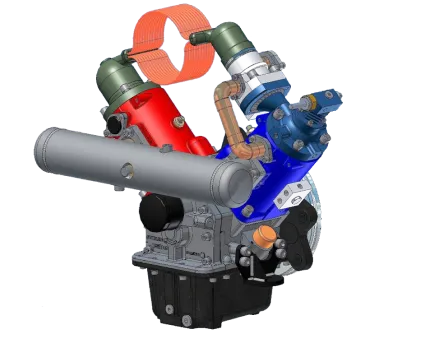
PCU 35 – power conversion unit
The PCU combines the Stirling engine, the generator and an external heat exchanger – the receiver. The receiver is a set of thin tubes filled with the working gas (helium) and transfers the concentrated radiation from the dish into the hot side of the Stirling engine. Placed in the cavity of the PCU, it absorbs concentrated thermal energy at 700–800 °C.
The heat absorbed in the working gas (~650 °C) is converted into mechanical energy in the expansion cylinder. The crank drive turns the generator at 1,500 rpm to produce clean electricity (400 V, 50 Hz, three-phase); the maximum operating speed is 1,800 rpm (60 Hz).
The PCU and engine are cooled by a closed loop with a blower and radiators, so no water is consumed in normal operation (coolant at the engine inlet: 45 °C, antifreeze). Water is used only to clean the mirrors – far less than CST, solar tower and trough plants.
Other integral parts: control system and switchboard with measurement and regulation, auxiliary helium pressure vessel and a heat-resistant ceramic shield. Production, assembly and quality control follow European standards (EN ISO 9001, EN ISO 14001, EN ISO 3834).
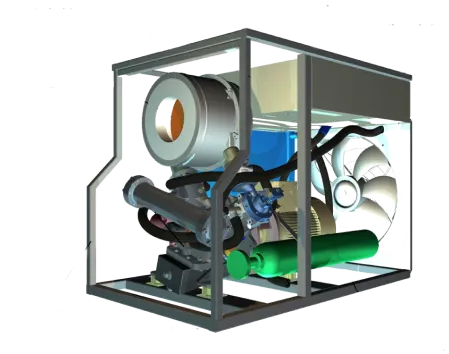
FlexiSunFold concentrator
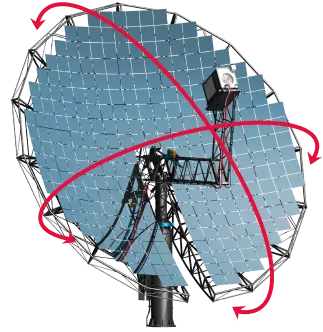
The solar concentrator is the primary solar component of Dish Stirling technology. The prefabricated, hot-dip galvanised steel parabolic concentrator delivers the sun's energy into the focal point, where the PCU with the Stirling engine's receiver is placed. Concentrator area: 57 m².
Two-axis tracking: azimuth and elevation. Main parts: PCU with Stirling engine, mirrors, supporting arm and bracket, supporting frame, switchboard and control system.
Solar mirrors SunReflect Pro
Sandwich-construction solar mirrors with a high precision of 1 mrad and resistance to weather conditions – built to reflect sunlight precisely into the receiver of the Stirling engine.
SunScorpio
A patented mobile Dish Stirling plant on a shipping-container platform, powered by our new-generation SBT24e Stirling engine.
SBT24e – new-generation Stirling engine
SunScorpio uses a new Stirling engine currently in development, targeting at least 24 kW of electrical output (target completion 2027). It is designed for both solar and combustion micro-cogeneration.
FlexiSunFold concentrator
Designed for maximum flexibility: automatic folding and unfolding makes transport and installation fast. The concentrator tracks the sun in azimuth and elevation throughout the day.
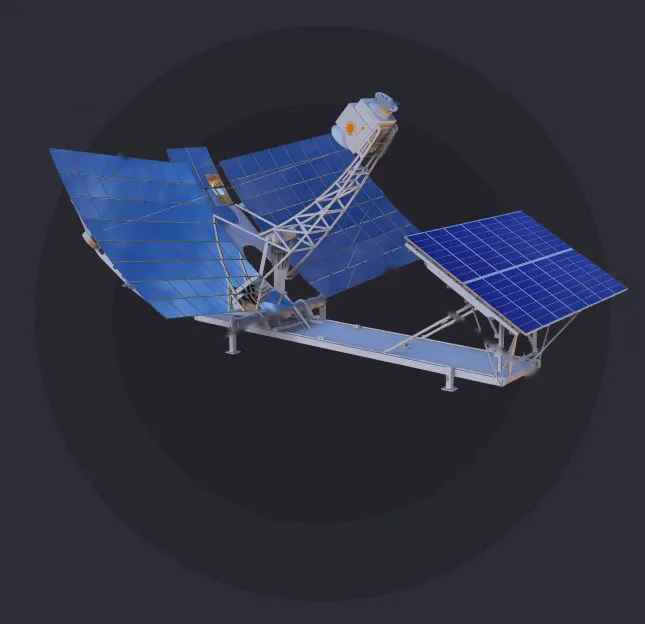
Foldable design
The whole system unfolds automatically into a fully functional plant and folds back into the container when an operation is complete – so the plant can be deployed and dismantled according to actual needs, with no foundations.
PV wall
The container surface that holds the folded concentrator arms during transport carries photovoltaic panels, adding to the system's output.
CSP Dish Stirling vs. other solar technologies
The technology unlocks several use cases at once, which makes it a versatile, lower-risk asset.
| Capability | Photovoltaic | CSP Dish Stirling | Solar tower / trough |
|---|---|---|---|
| Electricity | ✓ | ✓ | ✓ |
| Heat | – | ✓ | ✓ |
| Solar cooling | – | ✓ | ✓ |
| Thermal desalination | – | ✓ | ✓ |
| Green hydrogen production | – | ✓ | – |
| Mobile solution | ✓ | ✓ | – |
| Pre-assembled, foundation-free (SunScorpio) | ✓ | ✓ | – |
| Full and smart dispatch | – | ✓ | ✓ |
| Energy storage potential | ✓ | ✓ | ✓ |
| Off-grid | ✓ | ✓ | – |
| Smart, micro and mini grids | ✓ | ✓ | – |
| Rugged rocky terrain | – | ✓ | – |
| Easy local production | – | ✓ | – |
| Cooling without water | ✓ | ✓ | – |
| Constant peak production | – | ✓ | ✓ |
| Quick installation and dismantling | ✓ | ✓ | – |
| Rating | Photovoltaic | CSP Dish Stirling | Solar tower / trough |
|---|---|---|---|
| Potential to increase efficiency | Medium | High | Medium |
| Durability | Medium | High | Low |
| Energy security | Medium | High | Low |
| Change to installed capacity | High | High | Low |
| Total efficiency | Low | High | Medium |
| High-temperature applications | Low | High | Medium |
| Dual land use | Low | High | Medium |
| Clean-cooking ready (SDG 7) | Medium | High | Medium |
Off-grid and smart grids: CSP Dish Stirling allows remote management of supply, including switching on/off and selecting the output power. No water is needed for cooling. The design can be produced locally to cut costs and the carbon footprint.